 LowestCode
AI NoCode & LowCode Office and Business Operating System
LowestCode
AI NoCode & LowCode Office and Business Operating System
by
The LowestCode Quest:
One AI Agent Guided by One Human Creates an Office and Business Suite in Six Months
Much of what you see runs today, the rest the Quest will show: a range like a large vendor's, possible because LowestCode is one system, not many products.
-
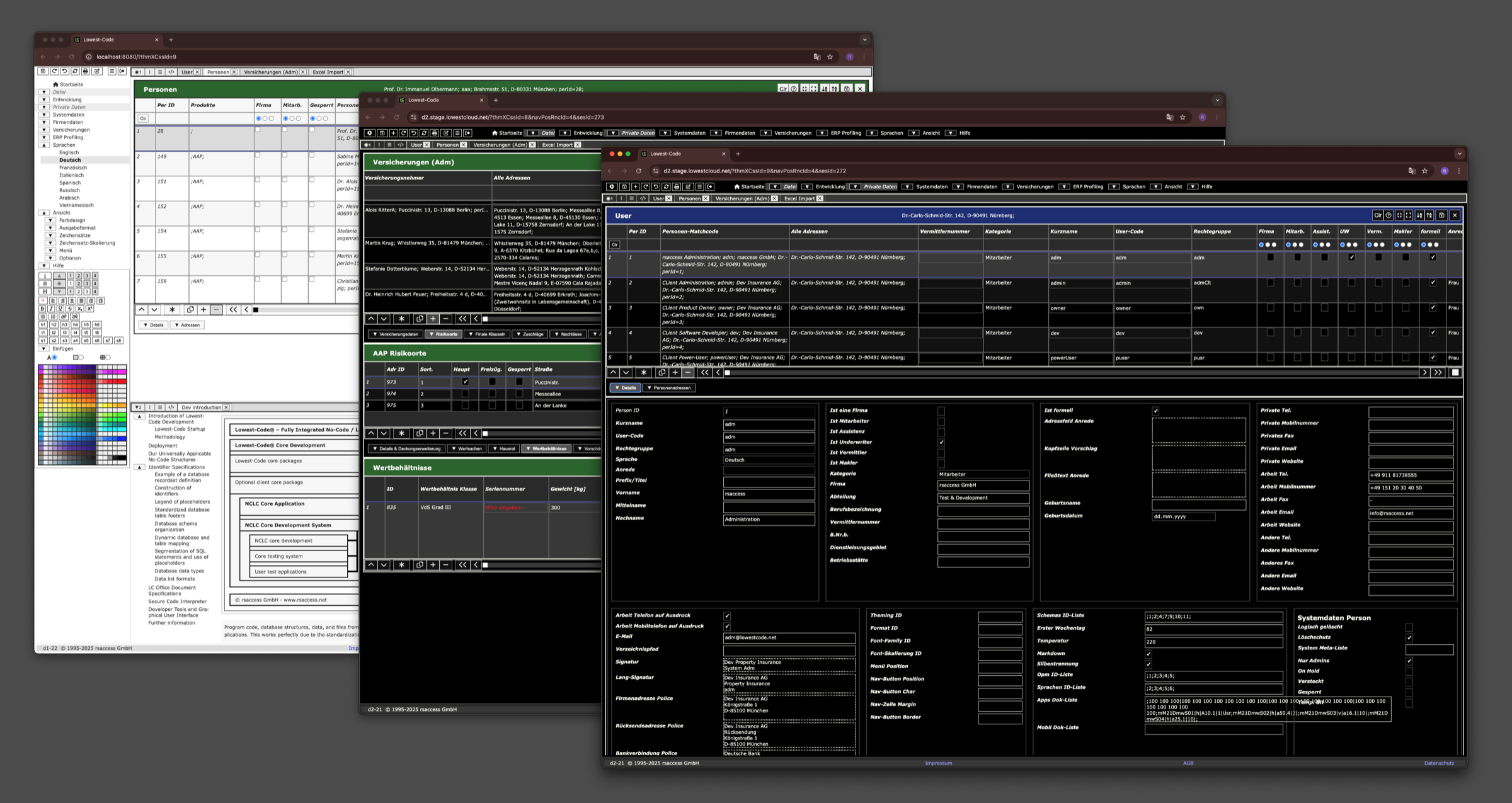 The workplace: several windows of one system side by side, in three themes
-
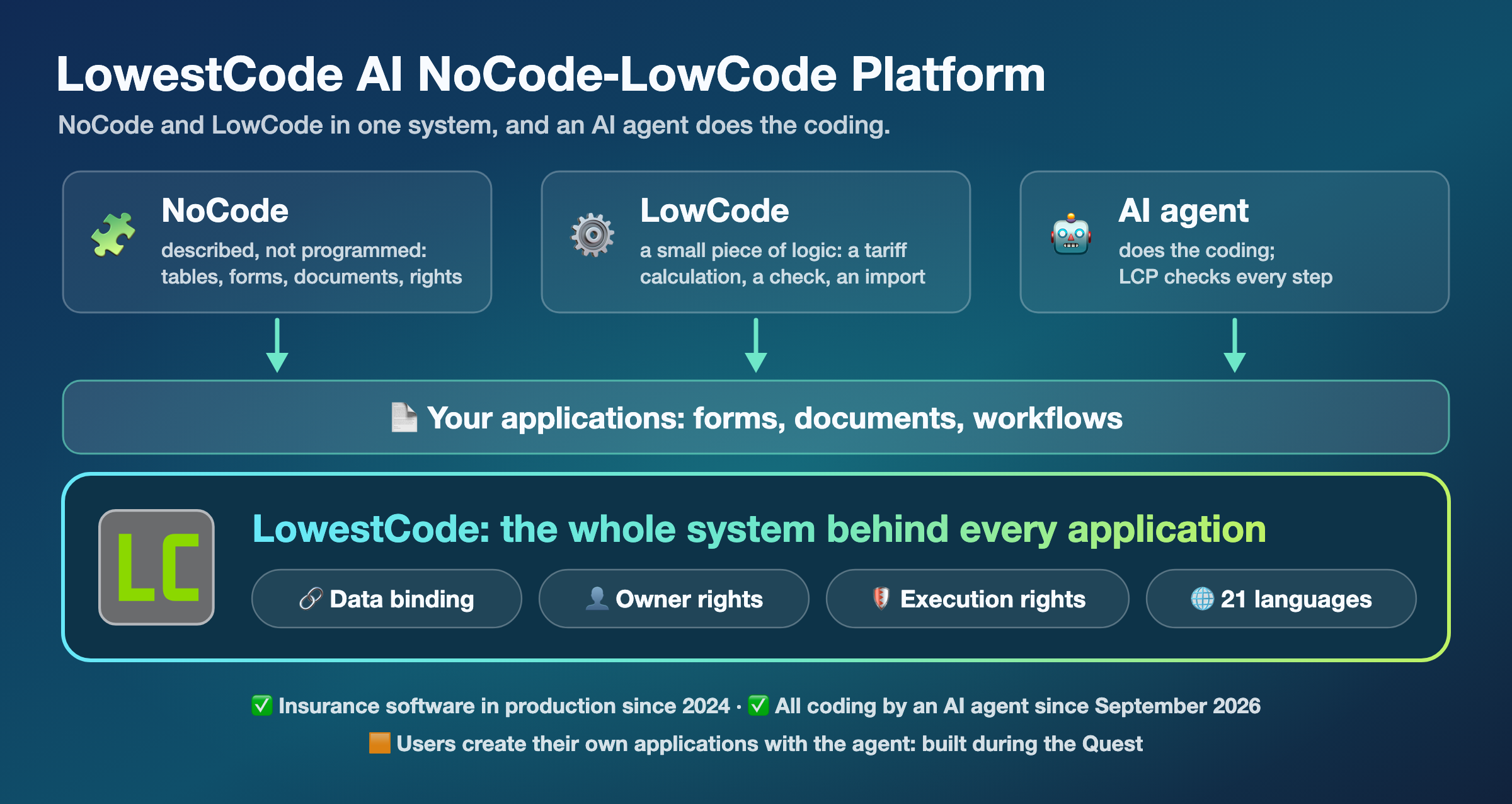 NoCode, LowCode and AI: the whole system behind every application
-
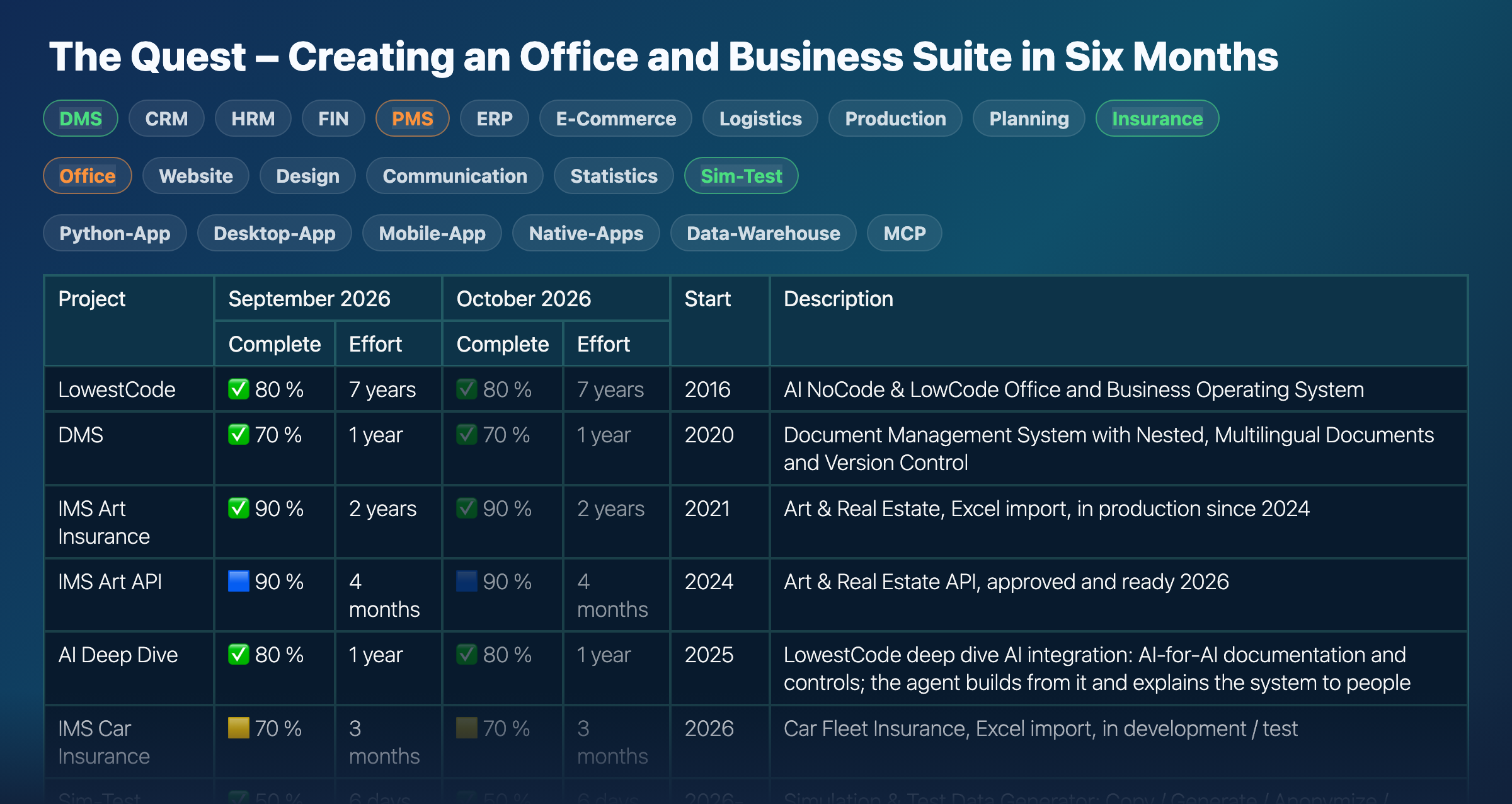 The Quest – updated every month
-
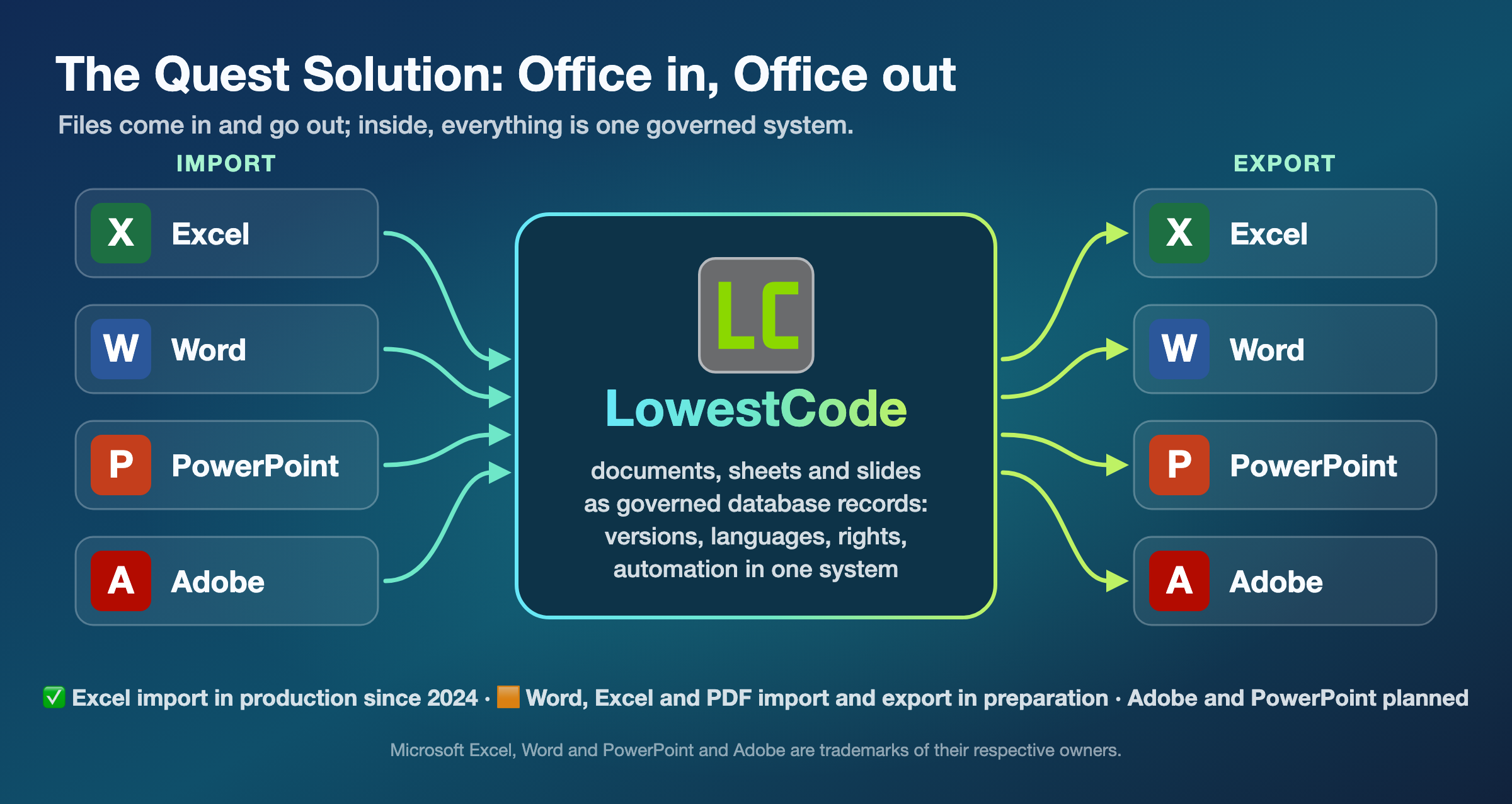 Import and export with Office tools
-
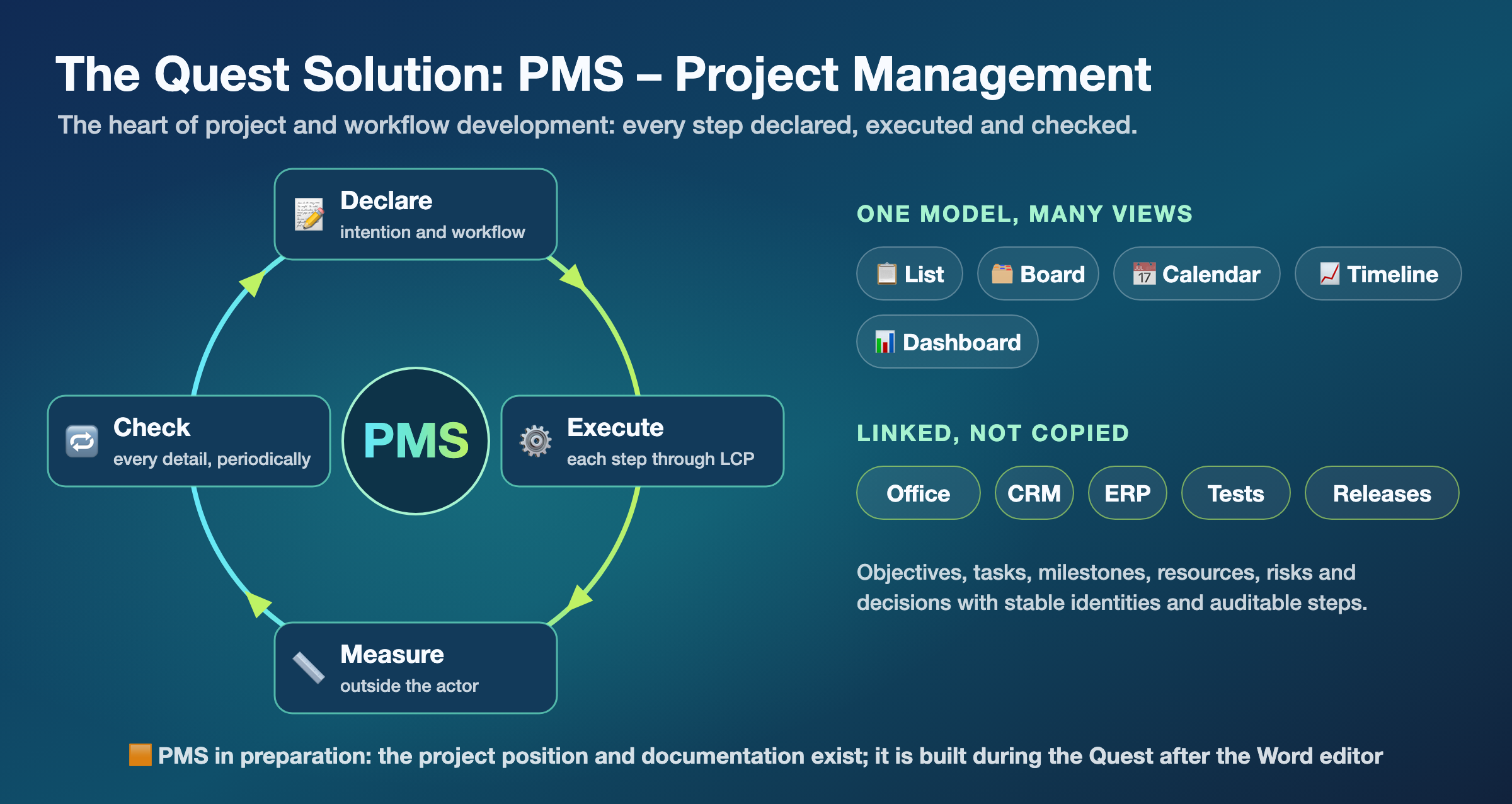 PMS: projects and workflows, declared and checked
-
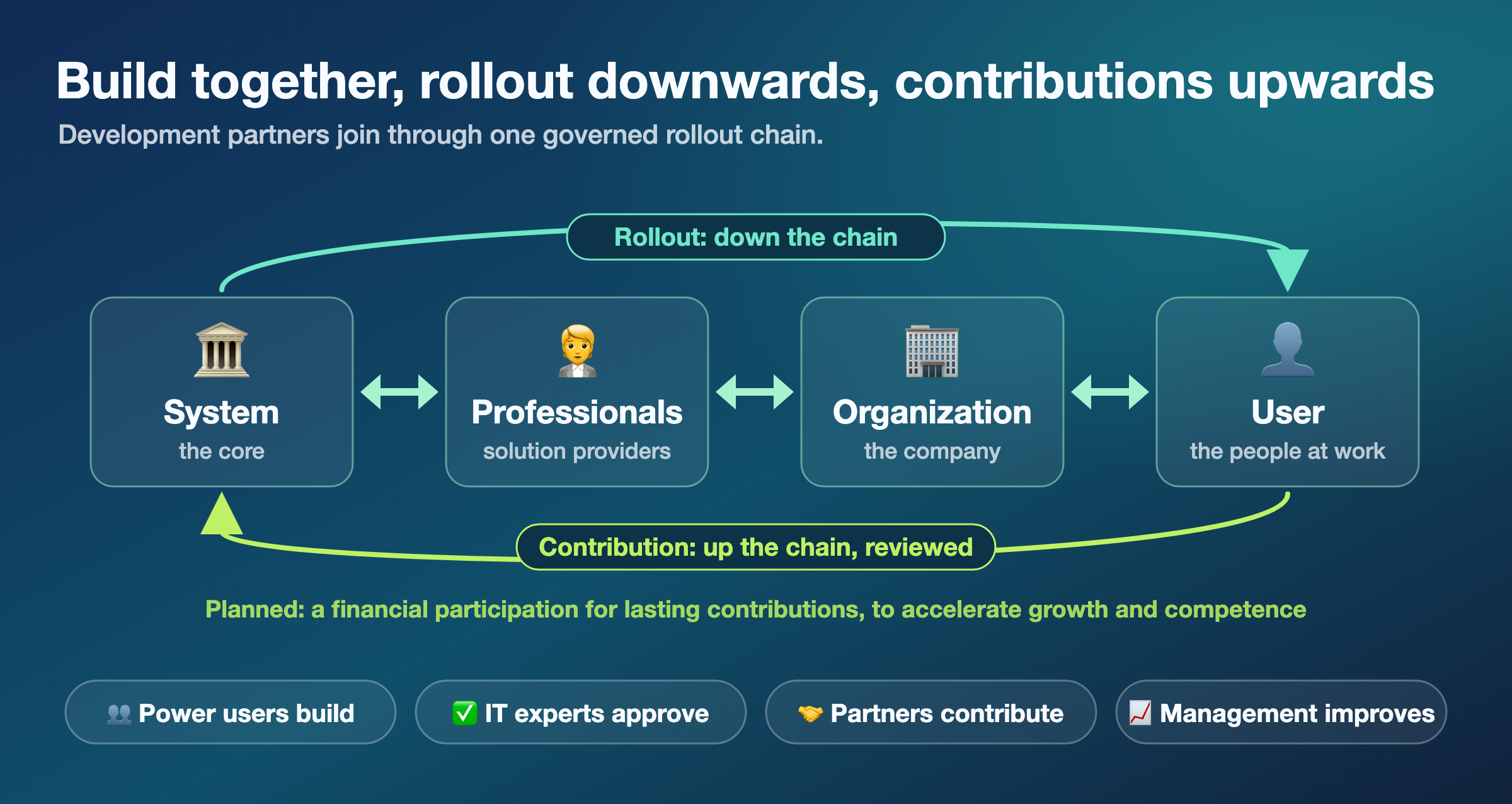 The rollout and contribution chain
-
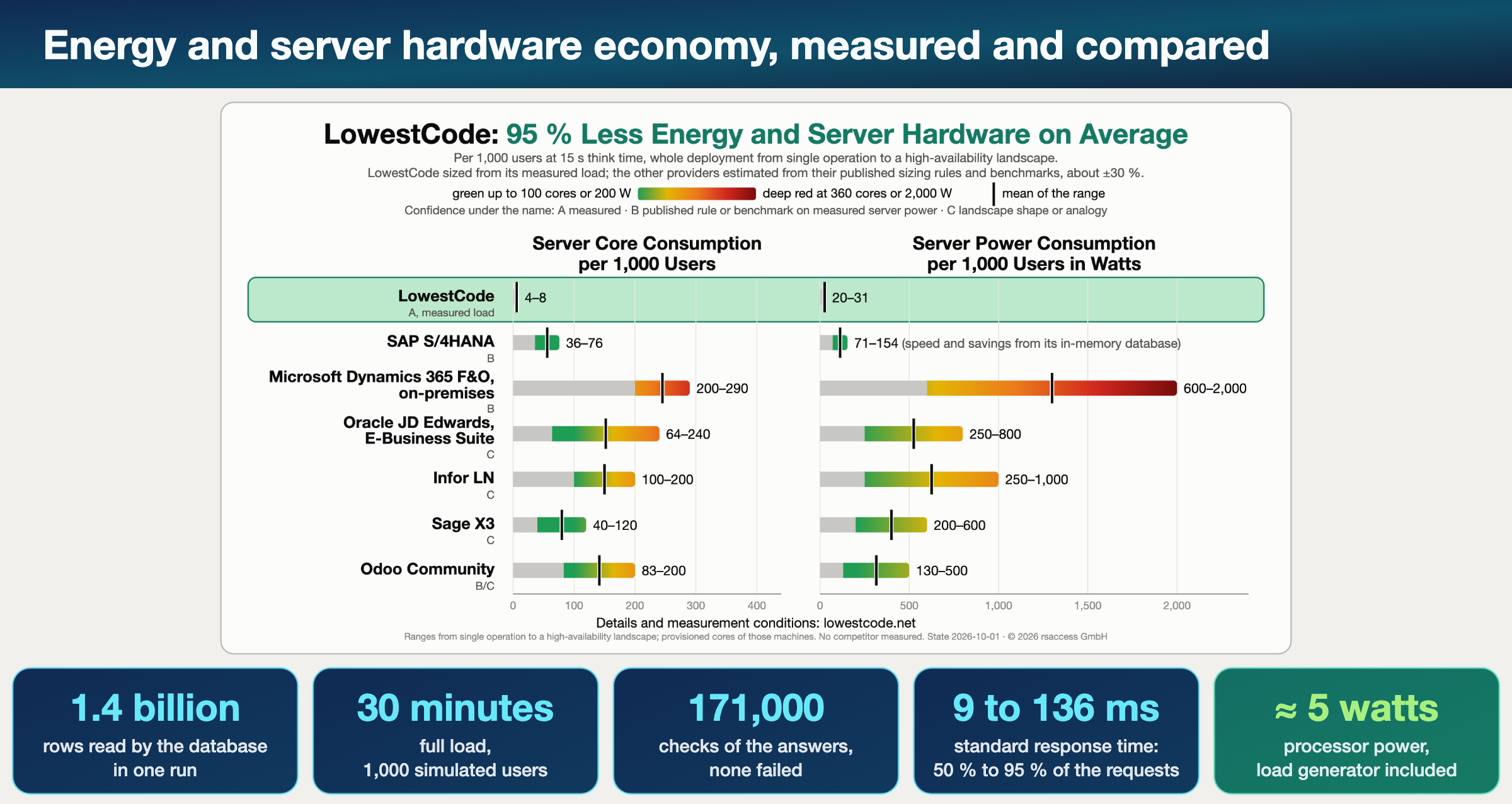 Energy and server hardware per 1,000 users
-
 Innovation and cooperation
Click to jump to a section: the Quest, where our projects stand, what we modernize for customers, how your team works with it, the platform behind it, the workplace, the energy and server comparison, innovation and cooperation, and the summary.
The Quest.
One agent builds.
LowestCode controls.
Six months, October 2026 to March 2027, with monthly KPIs as public, verifiable proof.
One AI agent creates DMS, CRM, HRM, FIN, PMS, ERP, Insurance, Office, Website, Design, Communication, Statistics, Sim-Test, and more on LowestCode AI. The LowestCode Communication Protocol (LCP) controls coding and execution in every phase.
We don't write code anymore
Since September 2026, 100 % of our development runs through AI agents, in harmony with the system: LowestCode conditions the agent, answers every coding step with live feedback, and its security and controls step in when needed. We set direction and review. Users and developers will create applications the same way. Today one person does this work: the founder sets direction and reviews, the agent codes. The platform under it is ten years of development, with much input from real projects.
What the Quest will prove
Safe and controlled AI-only coding is reality and delivers.
One system for all common Office and business tasks.
Qualified AI / human error statistics: once obvious errors are handled, a remaining error is as often a definition, a preparation, or a human error as the AI's.
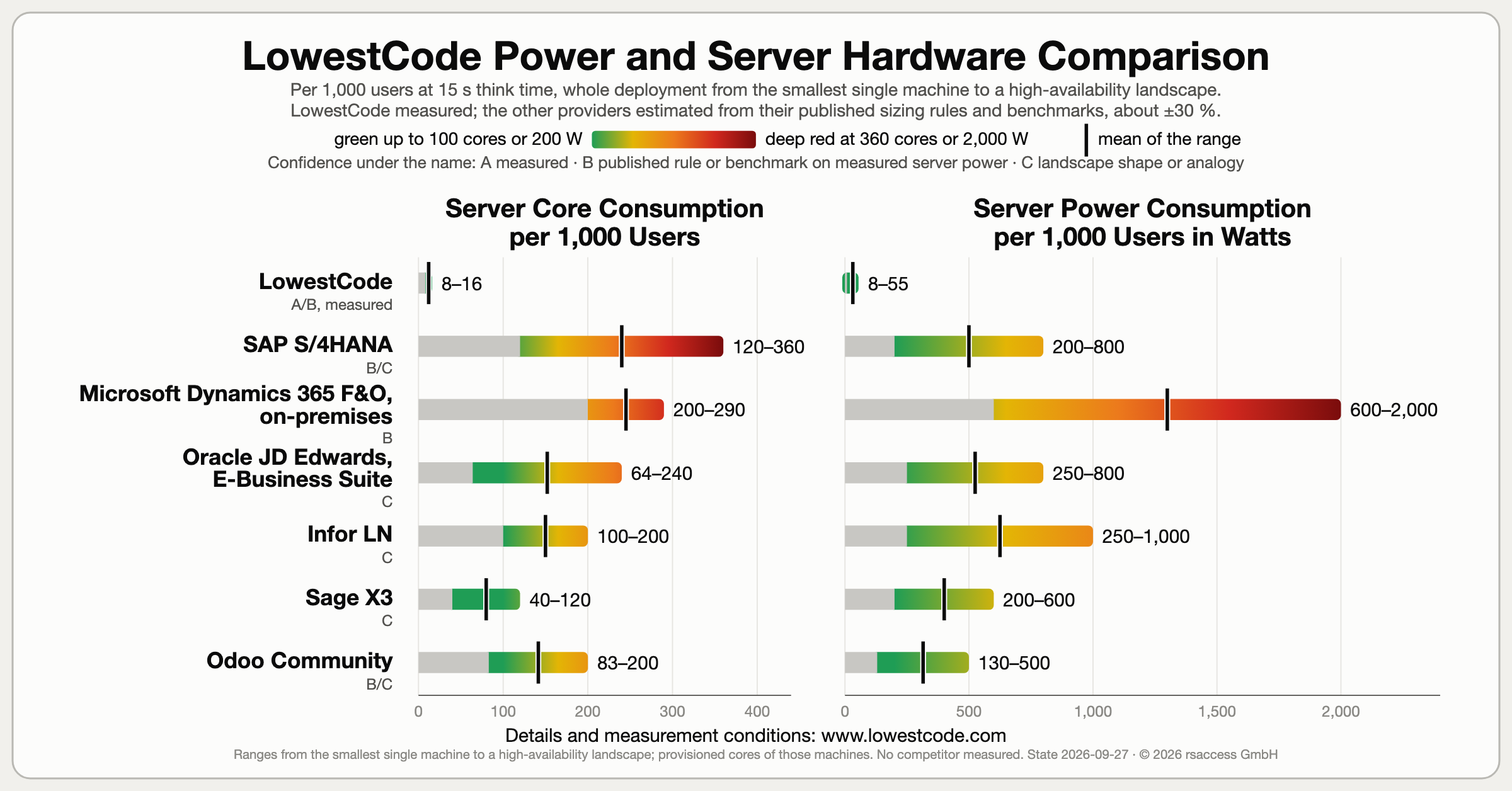
95 % less energy and server hardware on average, compared with six leading business systems; SAP comes closest.
Less effort and energy for AI application creation, through LowestCode automation and self-learning.
10 to 30 times faster for core database and cloud operations, compared with the same stacks.
AI and cloud security with data protection, each designed for its EU rules: the EU AI Act for the AI, GDPR and the EU cybersecurity rules for the cloud.
A better user interface with multiple windows and built-in AI support for documents and coding.
21 application languages from the start.
Where our projects stand As of
- DMS
- CRM
- HRM
- FIN
- PMS
- ERP
- E-Commerce
- Logistics
- Production
- Planning
- Insurance
- Office
- Website
- Design
- Communication
- Statistics
- Sim-Test
- Python-App
- Desktop-App
- Mobile-App
- Native-Apps
- Data-Warehouse
- MCP
| Project | September 2026 | October 2026 | Start | Description | ||
|---|---|---|---|---|---|---|
| Complete | Effort | Complete | Effort | |||
| LowestCode | ✅ 80 % | 7 years | ✅ 80 % | 7 years | 2016 | AI NoCode & LowCode Office and Business Operating System |
| DMS | ✅ 70 % | 1 year | ✅ 70 % | 1 year | 2020 | Document Management System with Nested, Multilingual Documents and Version Control |
| IMS Art Insurance | ✅ 90 % | 2 years | ✅ 90 % | 2 years | 2021 | Art & Real Estate, Excel import, in production since 2024 |
| IMS Art API | 🟦 90 % | 4 months | 🟦 90 % | 4 months | 2024 | Art & Real Estate API, approved and ready 2026 |
| AI Deep Dive | ✅ 80 % | 1 year | ✅ 80 % | 1 year | 2025 | LowestCode deep dive AI integration: AI-for-AI documentation and controls; the agent builds from it and explains the system to people |
| IMS Car Insurance | 🟨 70 % | 3 months | 🟨 70 % | 3 months | 2026 | Car Fleet Insurance, Excel import, in development / test |
| Sim-Test | ✅ 50 % | 6 days | ✅ 50 % | 6 days | 2026-04 | Simulation & Test Data Generator: Copy / Generate / Anonymize / Import |
| LCP-Chat | 🟨 40 % | 5 days | 🟨 40 % | 5 days | 2026-08 | LowestCode Communication Protocol: Document & LCP Request AI Chat; System Chat in preparation |
| Office-Text | 🟧 20 % | 10 days | 🟧 20 % | 10 days | 2026-08 | LowestCode Office Text Documents with Word & PDF Import/Export |
| Office-Calc | 🟧 10 % | 5 days | 🟧 10 % | 5 days | 2026-08 | LowestCode Office Table Documents with Excel Import/Export |
| PMS | 🟧 5 % | 2 days | 🟧 5 % | 2 days | 2026-09 | Project Management System - prepared for structural integration |
| … | … | … | … | … | … | More projects to start soon |
✅ In production · 🟦 Ready · 🟨 In test · 🟧 In preparation · ❌ Canceled
September 2026 shows the start values of the Quest, October 2026 the current values. Completeness is estimated, effort is the working time spent. A value that did not change since the month before is shown muted.
… The table is open: a planned project gets its row when work on it starts, and the table grows until every planned project is built out.
From proven workflows to maintainable applications Modernize business-critical workflows without losing proven business logic.
We transform insurance processes, enterprise workflows, Excel workbooks, and VBA applications into maintainable software for European cloud and desktop environments. LowestCode begins with the business logic that already creates value and gives it a controlled path forward.
-
Insurance
Products, calculations, documents, and processes developed around real operational needs.
-
Excel & VBA
Valuable workbook logic moved into maintainable, shared applications.
-
Enterprise workflows
Data, forms, rights, documents, and automation brought into one model.
-
European deployment
Cloud, private, and desktop options, designed for EU data protection and conformity.
- Preserve business logic
- Reduce fragmentation
- Control change
- Support long-term use
Power users deliver.
IT experts guide.
Development partners join through one governed rollout chain.
The LowestCode rollout system lets development partners build independently without interfering with one another, as the integrated AI agent does the coding and keeps it consistent.
- System
- Professionals
- Organization
- User
Contributions travel up the chain in a controlled way. Once we are established on the market, we plan a participation system that rewards lasting contributions.
- User
- Organization
- Professionals
- System
-
Power users meet the internal needs
The people who know the work build the forms, documents, and workflows they need, without code, and make adjustments themselves as the business changes.
-
IT experts guide and control
An IT expert introduces each project, advises and accompanies the power user, checks the result, and gives the final approval. Architecture, security, and data stay in professional hands.
The AI agent does the coding, with the system's expertise built in and its checks behind every step. -
IT experts freed for what usually waits
Relieved of routine application work, IT experts take on the higher-level tasks that normally get neglected: integration, security, and intelligent global solutions and helpers for the whole company.
-
A better-run company
Internal needs are met quickly, professional control stays in place, and expert time goes where it counts: an overall improvement of company management and business development.
- Power users build
- IT experts approve
- Partners contribute
- Management improves
LowestCode AI NoCode‑LowCode Platform LowestCode is what AI needs: NoCode and LowCode in one integral, compact system for Office and business applications, and LCP controls every step. The result is controlled agent coding, high coding efficiency, and a clear interface for people.
Productive insurance software has been licensed and used since 2024, with continuing development and integration into established systems. LowestCode preserves proven logic while modernizing how it is operated.
Why LowestCode
What a power user needs without code is what an agent needs: one governed system for data, interfaces, documents, rights, translations, and automation. Guided by LCP, an AI agent is designed to implement faster and more consistently than hand coding; people set direction and review, and system rules retain control.
-
Build without code
The people who know the work say what they need. Your applications will be created and maintained by an AI agent under LowestCode's control, and proven business rules are kept instead of starting from zero.
-
Change safely
Controlled NoCode, LowCode, and AI-assisted changes are validated and can be reversed. Deeper development runs on synthetic data; customer data stays in production.
-
One system
Data, forms, documents, rights, and automation follow one model, so the whole system stands behind every application, with data binding and with owner and execution rights controlled. 21 application languages from the start.
-
Run it your way
European cloud, private environments, or controlled desktop use, with no license fees for components. AI agents and cloud hosting are external services with their own terms.
One workplace.
One development IDE.
Many windows.
One shell for any application, the Office suite on its way.
Your windows, ready when you log in
Your windows and their layout are saved and preloaded, ready the moment you log in. Working environments can be defined for each task and guarded by rights. Windows sit side by side, and the same document can be open in many of them, working in sync. The same system is your workplace and your development and test environment, so you build your own applications there and test them on synthetic data before they reach production.
One menu, two views, one toolbar
The navigation is one menu shown two ways, as a side tree or as a top menu. The side menu doubles as the toolbar, with the HTML editor's controls in it, as on the left of the picture. Themes and formats change the look, not the content.
Office on its way
Planned: text documents with Word and PDF import and export, table documents with Excel import and export, presentations with PowerPoint, and notes, tasks, reports, forms and designs, all governed documents of the one foundation, to complement or replace Microsoft Office and Adobe tools. Of the Quest's four expansion candidates, Office, Design, Communication and Statistics, Office is the focus, starting October 2026.
95 % less energy and server hardware on average Compared with six leading business systems; SAP comes closest.
LowestCode keeps about one core busy for 1,000 users, measured; sized with headroom and a standby, that is four cores, eight with high availability on two sites. Five of the six other systems need far more by their own published sizing rules.
- 1.4 billionrows read by the database in one run
- 30 minutesof full load
- 171,000checks of the answers, none failed
- 9 to 136 msstandard response time: 50 % to 95 % of the requests
- ≈ 5 wattsprocessor power, load generator included
The numbers, their sources and the measurement are on these pages; no competitor product was measured. All product names are trademarks of their respective owners.
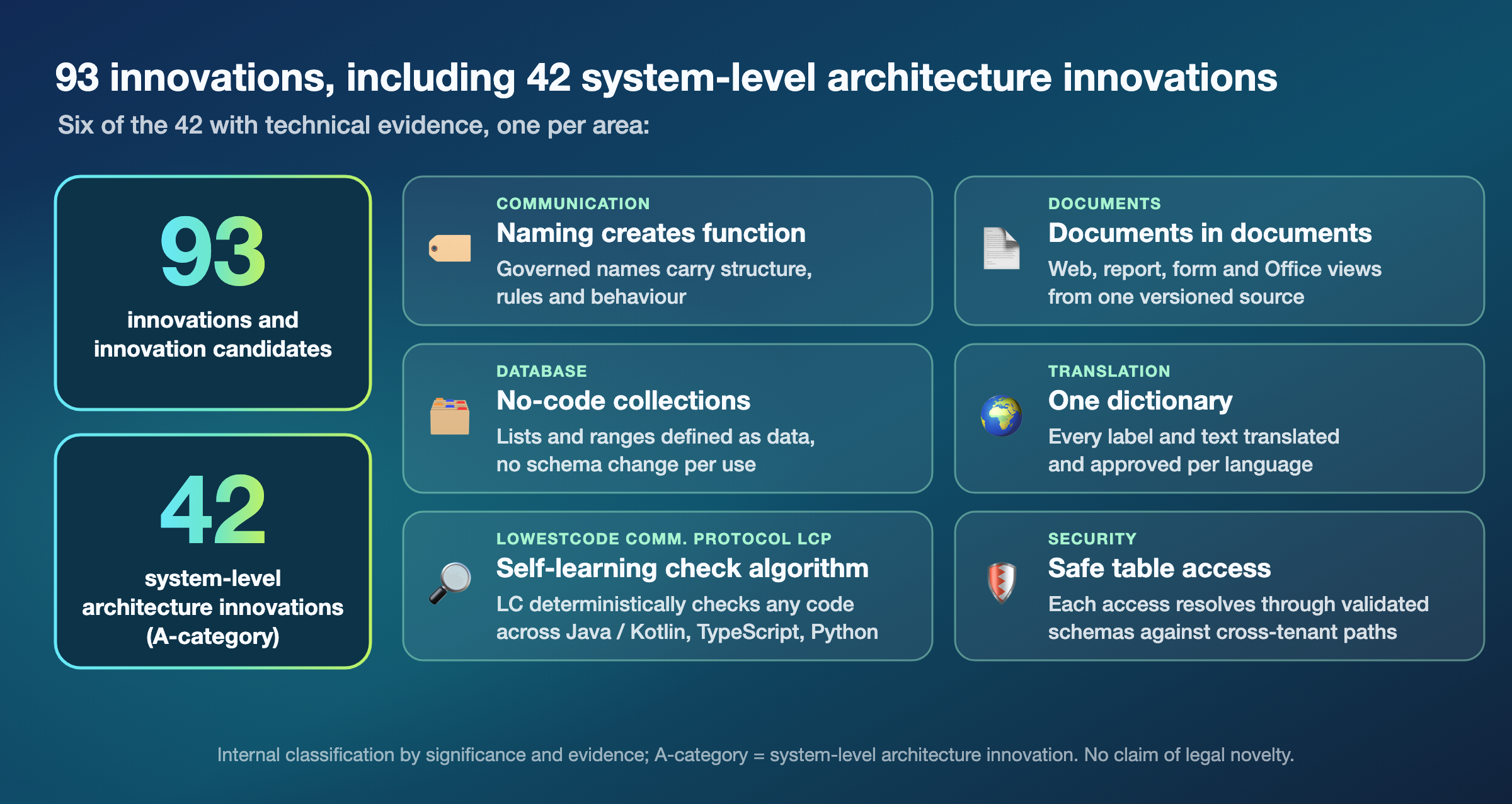
A structured innovation portfolio grounded in working software Deterministic AI, internationalization, digital sovereignty, and measurable efficiency.
We have structured a portfolio of 93 innovations and innovation candidates, including 42 system-level architecture innovations (A-category). They rethink how database semantics, documents and interfaces, automation, AI governance, security, and deployment work together.
On this basis we are preparing a research grant application to the German research ministry (BMFTR, formerly BMBF) and are looking for a university partner: companies are funded at 50 to 70 %, universities up to 100 %. The project validates what the working system shows today: energy efficiency, security by design for the EU rules, and full and secure AI integration in application creation and documents. Our thesis: AI needs an integral, compact system with governed controls. LowestCode is built that way, and LCP controls every step.
-
Customers
Modernize one valuable workflow with a practical delivery path.
-
Developers
Build and improve governed applications with inspectable tools.
-
Universities
Study reproducibility, AI control, efficiency, and multilingual systems.
-
Investors and partners
Support customer-led growth and the validation of a reusable platform.
AI providers and cloud hosting
Offer the LowestCode Office and Business Operating System as your own application layer. Your model becomes the agent that creates and maintains every application throughout its life, and LowestCode keeps it on track: it prepares the agent, checks every step, and decides the rights once before anything runs. Every seat adds recurring revenue on top of your models and hosting. Terms are open, from distribution to deeper collaboration, and every cooperation starts small, with a technical review or a pilot.
Implementation partners
Bring LowestCode to your customers: insurance modernization, Excel and VBA migration, and business applications. The AI agent does the coding, and your team guides it.
Self-learning, built to continue
Accepted AI work becomes predefined, reusable modules without training a model, and deterministic controls keep authority, auditability and rollback. A governed step is designed to run 10 to 100 times faster than an AI agent reasoning it through, and more safely: within narrow controls, with the owner and user rights applied to every step. The knowledge lives in the system, not in one head: every working session starts a fresh agent that picks up the system from there, and a partner team joins the same way.
AI-for-AI: one documentation, two uses
LowestCode's documentation is written by the AI agent for the AI agent: compact, structured and complete. It covers the whole system and states for each part what is built and what is planned. That gives it a second use. The same agent explains the system to people in detail: a developer asking how a rule works, a specialist joining a project, a partner team getting started. The answers come from the current documentation, not from a manual that fell behind.
LowestCode in short One integral, compact system for Office and business applications, and LCP controls every step. Many problems solved.
In use and measured today
- ✅Ten years of development, proven in real use: insurance software licensed and in production since 2024.
- 🧠We don't write code anymore: since September 2026, 100 % of our development runs through AI agents, and the LowestCode Communication Protocol (LCP) controls coding and execution in every phase.
- ⚡About one busy core for 1,000 users, measured: in one 44-minute load run the database reads more than 1.4 billion rows, and the device does not even get warm.
- ⚡80 to 99 % less energy and server hardware than five of six leading business systems, from our measured load and their own published sizing rules.
- 🌍21 application languages from the start, and each partner can add languages or define dialect variants; right-to-left scripts, time zones and country formats are built in.
- 🆓No license fees for components: every third-party component is free open source. AI agents and cloud hosting are external services with their own terms.
How it works
- 👥Power users deliver, IT experts guide and approve, and the AI agent does the coding.
- 🏅One rollout and contribution chain: System ⬌ Professionals ⬌ Organization ⬌ User. Partners build independently, and contributions travel back up in a controlled way.
- 🔁Workplace, development IDE and test environment in one: customer data stays safe in production, deeper development runs only in synthetic test environments, and changes can be validated and reversed.
- 🛡️AI and cloud security with data protection, each designed for its EU rules: the EU AI Act for the AI, GDPR and the EU cybersecurity rules for the cloud.
- ♻️Self-learning by design: accepted AI work becomes predefined, reusable modules without training a model; a governed step is designed to run 10 to 100 times faster than an AI agent reasoning it through.
- ❤️AI-for-AI documentation: written by the agent for the agent, covering the whole system and kept up to date with every change; the same agent explains the system to people.
- 🧩Cross-platform by design: Java / Kotlin for the system, Python for science and data science.
- 🗄️PostgreSQL as the standard database, SQLite planned for mobile, MS SQL and MySQL for compatibility tests.
What the Quest will show
- 🚀The Quest: one AI agent, guided by one human, creates an Office and Business Suite in six months, October 2026 to March 2027, with monthly, public, verifiable proof.
- 📄One system for all common Office and business tasks: the Office suite is on its way, to complement or replace Microsoft Office and Adobe tools.
- ⚙️Spontaneous RPA in the same system: the AI agent writes an automation in KotlinScript when it is needed, the owner approves it, and LowestCode controls the coding and decides the rights before every run; an approved automation runs again on demand, without the agent.
- ⚡Designed to run core database and cloud operations 10 to 30 times faster than Dynamics, SAP, and classic ERP stacks; the Quest will measure it.
- 🤝Technology partners welcome now, before the Office and Business Suite goes on sale at the end of the Quest in March 2027; a university partner is sought for a research grant application.
LowestCodeLowestCode © Dr.-Ing. Raimund Reisacher · sold and hosted by rsaccess GmbH
This document is available in English only. It is the text we check and verify.
LowestCode AI NoCode & LowCode Platform: Technical Data
This page gives developers and technology partners the technical data of the LowestCode platform: what it runs on, how its data is built, how applications are generated and changed, and how it is operated. It says what is built today and what is planned. State: 2 October 2026.
In short
- The server runs on Java / Kotlin, the browser layer is TypeScript, and PostgreSQL is the standard database.
- One model: table definitions drive the storage, the forms and the input checks, and every user interface is a document in the database.
- Every table carries the same fields for validity, audit, protection and rights, and every text field is multilingual.
- An AI agent does the coding through the LowestCode Communication Protocol (LCP), which checks a request and decides its rights once before anything runs.
- Production, development and test are separate environments. Customer data exists in production only.
Program languages and runtimes
- Java / Kotlin for the system. LowestCode runs on Java / Kotlin: strict types and fixed contracts keep the system deterministic. The server framework is Kotlin/Ktor.
- TypeScript in the browser. The browser layer is written in TypeScript and compiled to JavaScript. Every runtime that serves a browser shares it.
- Python for science. Python complements the system where science and data science need it, with its analysis, AI and machine-learning libraries. The Python version is designed as a full cloud version of LowestCode, not a set of tools: it shares the database and the user interface with the Java / Kotlin version, so it can deliver results directly to users or through APIs. A first Python runtime slice exists; the data-science services are planned.
- Desktop. The desktop edition is designed to run the same code in an embedded browser. The desktop application is a planned project.
- Mobile. Mobile use runs in the browser. Native apps are planned.
Databases
- PostgreSQL is the standard database. The load test ran on PostgreSQL 14 with its default settings.
- MS SQL and MySQL serve compatibility tests. They are not released for operation.
- SQLite is planned for mobile.
- Each customer organization has its own schema, and each environment its own database.
One model
- The whole system behind every application. A form, a document or an automation is never a separate program. It binds to governed data through the table definitions, it has an owner, and the rights to view, to change and to execute are decided on the server. This holds for NoCode, for LowCode and for what the AI agent builds.
- Table definitions. Every table and every field is defined once, as data. The storage structure, the generated forms and the input checks follow from that definition.
- Names carry meaning. A governed name states the table, the content and the references of a field. Software and the AI agent read structure from names instead of reconstructing it for each task.
- One format per field. Every field has one data format, which fixes its type, its check and its presentation in every language.
- Lists as data. Categories, rate tables, text collections and parameter tables are entries, usable from any table without a change of the database structure.
- Everything shown is a document. Forms, reports, pages of this website and the workplace itself are documents in the database, with versions numbered major, minor and revision, one row per language and rights per version. A document can include other documents.
- Generated forms. Table and detail forms are generated from the table definitions and stored as documents. Forms and windows are prepared once and loaded ready, instead of being assembled on every request.
What every table carries
- Validity. Every row has a valid-from and a valid-to time. Parameters, taxes, texts, documents and user access are filtered and validated by date, and a change can be timed in advance.
- Audit. Every row records who created it and who changed it last, and when.
- Field tracking. Changes to selected fields are recorded with author and time.
- Protection. A row can be locked, put on hold, protected for administrators and protected against deletion. Deletion is soft.
- Rights. Rights are checked on the server on three levels; what the browser sends never grants a right.
Languages, time and formats
- 21 application languages are installed from the start. English, German and French form the checked reference core; a further language is activated after translation, review and a check of its interface.
- Text fields carry their language variants side by side. Labels, messages and menu entries come from one dictionary.
- A partner can add languages or define dialect variants, and a customer can change wording on its own layer without touching the system's terms.
- The interface supports left-to-right and right-to-left scripts.
- Times are stored in UTC and shown in each user's time zone from the IANA time zone database. Dates, times and numbers follow the formats of language and country.
Environments and rollout
- An installation has separate environments: production, development, user development, test and trial. Each is a complete sandbox with its own database, its own documents and its own files. Nothing is looked up across them.
- Customer data exists in production only. Development and the AI agent work in environments with the same structure and synthetic data.
- The test data comes from the system itself: Sim-Test copies and generates data from the table definitions.
- Rollout runs down one chain,
System → Professionals → Organization → User. Contributions travel up the chain after review. - In use today: the separate environments and the transfer from our development to the running site. The transfer between the levels of the chain is built and proved in the test environment. The reviewed contribution path upward is design.
The AI agent and LCP
- The agent proposes; LowestCode decides. A request is checked for its meaning, its names and its data types, then compiled in a restricted form.
- Before anything runs, LowestCode fixes the complete list of capabilities the request may use and makes one rights decision for the request and that whole list.
- The agent is an external model. LowestCode trains no model of its own. The contract for coding agents is provider-neutral by design; today one agent product is in use.
- The agent starts every session from the AI-for-AI documentation, which covers the whole system. A checker reads Java / Kotlin, TypeScript and Python sources against the governed names and reports deviations.
- Built today: this controlled path runs in our local development; in the cloud it is closed by default. Our own coding has been done by an AI agent since September 2026. Design, built and proved during the Quest: users and developers creating and changing their applications through the same path.
The details are on the pages AI and Cloud Security and Technology overview.
Operation
- LowestCode runs in European cloud environments, in private environments and as a controlled desktop installation. The cloud infrastructure is run in cooperation with rapiddweller.com.
- Measured: 1,000 users keep 1.2 processor cores busy, server and database together. Half of all requests are answered within 9 milliseconds, 95 % within 136 milliseconds. Sized for operation, that is 4 to 8 cores per 1,000 users. The measurement is described in the load test report.
- No license fees for components: every third-party component is used under a free open-source license and is listed with its license in the notices that ship with the software. AI agents and cloud hosting are external services with their own terms.
Built today and planned
- Built and in use: the Java / Kotlin server, the TypeScript browser layer, PostgreSQL, the one model with table definitions, generated forms and documents, validity, tracking and versions, the installed languages, the separate environments, and coding by an AI agent under LCP in our own development.
- Built as a first slice: the Python runtime.
- Planned: the data-science services of the Python version, the desktop application, SQLite for mobile, native apps, the release of further databases, and the path on which users create their own applications with the agent.
The plain-language side of this page is The LowestCode AI NoCode & LowCode Platform.